
Schema Markup for AI: How to Use Structured Data to Get Cited
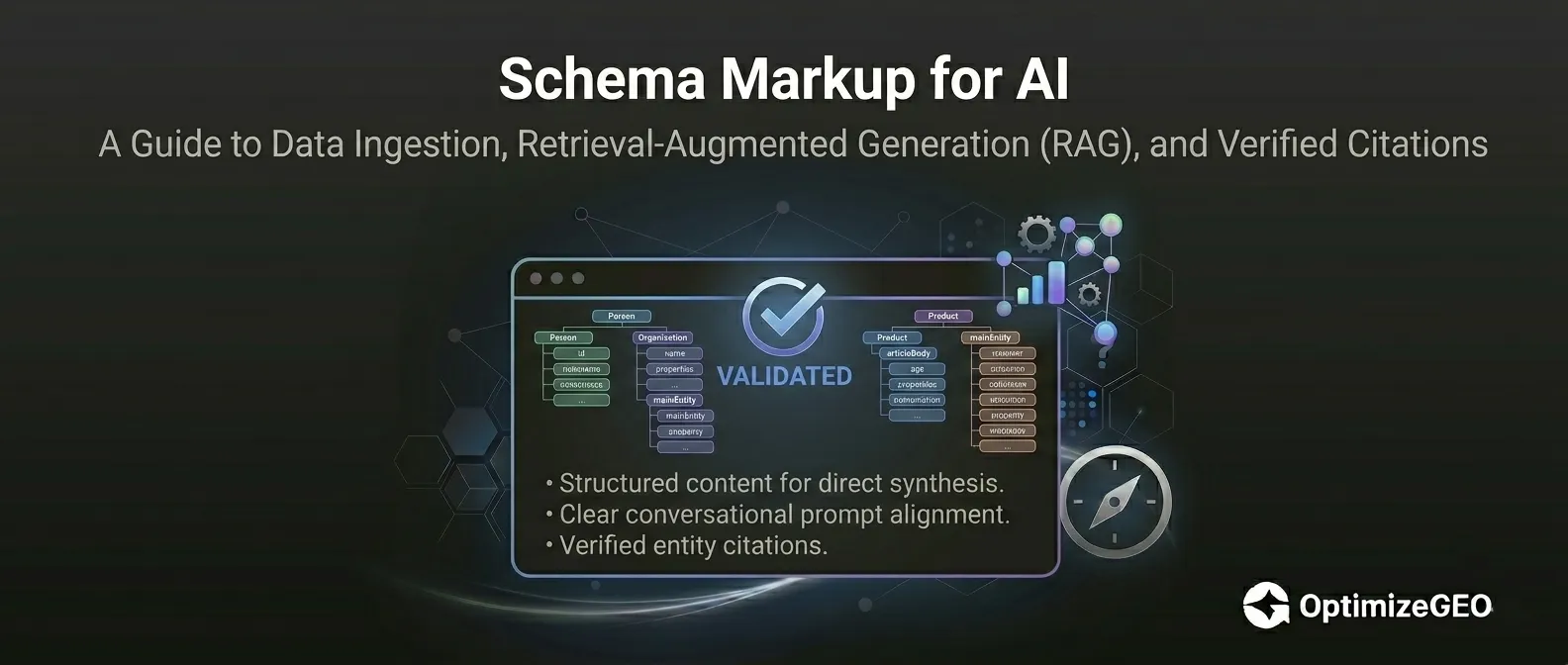
Most content optimization advice focuses on what you write. Schema markup is about how machines read what you've written - and in 2026, the machines doing the reading include ChatGPT, Perplexity, Gemini, and every other AI platform your customers are using to find answers.
Schema is the primary language for LLM tokenization. When an AI system processes your page, it doesn't experience it the way a human does - it tokenizes the HTML into structured data points and maps them into semantic relationships. Schema markup is the layer that makes those relationships explicit. It tells the AI what type of content is on the page, who wrote it, what questions it answers, and how authoritative the source is.
Without schema, an AI crawler has to infer all of this from context - and inference is less reliable than instruction. With schema, you're giving AI systems a machine-readable map of exactly why your content is worth citing. That's what makes your site citable rather than merely crawlable. For the broader technical foundation this sits within, see Prepare Website for LLM Searchability.
Why AI Search Engines Prefer JSON-LD
There are three ways to implement schema: JSON-LD, Microdata, and RDFa. For AI search, JSON-LD is the format that consistently performs best - and Google's own documentation recommends it as the preferred implementation.
The reason comes down to how AI systems process pages. JSON-LD lives in a <script> tag in the page <head> or <body> - separate from the visible HTML content. This means AI crawlers can parse your structured data without having to extract it from inline HTML attributes. It's cleaner, faster to process, and less prone to parsing errors that can cause schema to be misread or ignored.
More importantly, JSON-LD maps directly to the Q&A format that LLMs prefer when generating answers. A FAQPage schema block, for example, is structured as a list of question-answer pairs - which is exactly the format an LLM reaches for when it wants to include a clear, attributable response in its output. The schema pre-packages your content in the format the AI wants to cite. That alignment is why JSON-LD for AI search consistently outperforms inline schema implementations.
The practical implication: if you're currently using Microdata or RDFa for existing schema, migrating to JSON-LD is a worthwhile technical investment for AI citation purposes. New schema implementations should always use JSON-LD.
The "Big Three" Schema Types for GEO Success
Three schema types produce the majority of measurable AI citation improvements. Understanding what each one does - and why - helps you prioritize implementation correctly.
FAQPage Schema
FAQPage schema structures your Q&A content as a list of Question and Answer pairs that AI systems can extract independently. Each FAQ entry becomes a standalone, citable unit - the AI can pull a single answer from your FAQ section without needing to cite the entire page. This is the most direct path from schema to AI citation, because the content format mirrors what LLMs produce. Every FAQ answer is essentially a pre-formatted AI response.
Article Schema
Article schema provides the publication context that AI systems use to evaluate source credibility. It signals who wrote the content (linked to an Author entity), when it was published, when it was last updated, and what type of content it is (Article, TechArticle, NewsArticle). For AI citation purposes, the dateModified field is particularly important - it's how AI systems determine whether your content is fresh enough to be worth citing. A missing or outdated dateModified is a direct citation disadvantage.
HowTo Schema
HowTo schema structures process-based content as a sequence of HowToStep entries, each with a name and description. For instructional queries - how to set up X
, how to fix Y
, how to choose between A and B
- HowTo schema makes each step independently extractable. An AI building a step-by-step answer can pull individual steps from your content, with clear attribution, rather than having to synthesize instructions from unstructured prose.
Together, these three schema types cover the majority of content formats that AI systems cite: informational (Article), Q&A (FAQPage), and instructional (HowTo). For the full GEO context these sit within, see What is GEO?
Technical Guide: Implementing FAQPage Schema for AEO
FAQPage schema is the single highest-impact schema implementation for AEO and AI citation - because it creates the most directly extractable content format available. Here's how to implement it correctly.
Basic JSON-LD Structure:
{
  "@context": "https://schema.org",
  "@type": "FAQPage",
  "mainEntity": [
    {
      "@type": "Question",
      "name": "What is schema markup for AI?",
      "acceptedAnswer": {
        "@type": "Answer",
        "text": "Schema markup for AI is structured data that tells AI
        crawlers what your content is, who wrote it, and what
        questions it answers - making your pages easier to cite
        in AI-generated responses."
      }
    }
  ]
}
Implementation best practices:
- Place the JSON-LD block in the
<head>of the page or immediately before</body> - Each
Answertext should be self-contained - the answer should make sense without requiring the user to read surrounding page content - Keep answers between 40 and 110 words - long enough to be complete, short enough to be directly extractable
- Align FAQ questions with how users actually phrase queries to AI platforms, not just traditional keyword targets
- Validate using Google's Rich Results Test before publishing - malformed FAQPage schema is ignored entirely
The 1.8x Citation Lift: Stacking Article and HowTo Schema
Implementing any single schema type improves your citation eligibility. Implementing all three together - FAQPage + Article + HowTo - produces a measurably stronger result.
Triple-stacking JSON-LD schema blocks produces 1.8x more AI citations than Article schema alone. This isn't an additive effect where each schema type contributes independently. It's a compounding signal - when AI systems see a page with multiple schema types that are internally consistent and point to the same author, publication date, and content type, it reinforces the credibility of the entire page.
The correct way to stack schema is using @graph - a single JSON-LD block that contains multiple schema types linked by their shared @id references:
{
  "@context": "https://schema.org",
  "@graph": [
    {
      "@type": "Article",
      "@id": "https://example.com/page#article",
      "headline": "Schema Markup for AI",
      "author": {"@id": "https://example.com/author/name#person"},
      "datePublished": "2026-01-15",
      "dateModified": "2026-05-20"
    },
    {
      "@type": "Person",
      "@id": "https://example.com/author/name#person",
      "name": "Author Name",
      "jobTitle": "GEO Strategist",
      "sameAs": ["https://www.linkedin.com/in/authorname"]
    },
    {
      "@type": "FAQPage",
      "mainEntity": [...]
    },
    {
      "@type": "HowTo",
      "name": "How to implement schema markup for AI",
      "step": [...]
    }
  ]
}
The @graph approach links your Article, Author, FAQPage, and HowTo entities together - so AI systems see a coherent, internally referenced content object rather than isolated schema blocks. This is what triggers the 1.8x citation lift. The GEO & SEO Best Practices 2026 guide covers how schema stacking fits into the broader technical GEO foundation.
Author and Person Schema: Building E-E-A-T
Schema markup isn't just about content types - it's about establishing who is behind the content. Author and Person schema are the technical implementation of E-E-A-T's Expertise and Experience signals.
An Author entity linked to your Article schema tells AI systems: this content was written by a specific, identifiable person with verifiable credentials. It connects your content to a real-world expert - not just a nameless page on a website.
Key fields that matter for AI citation:
{
  "@type": "Person",
  "@id": "https://example.com/author/name#person",
  "name": "Author Name",
  "jobTitle": "Senior GEO Strategist",
  "description": "Expert in AI search optimization with 8 years
  of experience publishing research on LLM citation behavior.",
  "url": "https://example.com/author/name",
  "sameAs": [
    "https://www.linkedin.com/in/authorname",
    "https://twitter.com/authorname"
  ]
}
The sameAs field is particularly important for AI crawler metadata - it links your Author entity to third-party profiles that AI systems can cross-reference independently. When Gemini or ChatGPT encounters your author's name in the schema, it can verify their existence and authority through the LinkedIn or academic profiles listed in sameAs. This cross-referencing is exactly what builds the entity trust that drives LLM schema optimization.
For content in YMYL categories - finance, health, legal - Author schema with verifiable credentials isn't optional. It's the threshold signal that determines whether AI systems treat your content as safe to cite at all. The Zamp AI Search Foundation Case Study shows how E-E-A-T schema implementation contributed to a 22% discoverability improvement for a fintech brand operating in exactly this environment.
Schema Markup for Products: Ranking in "Best" Prompts
For e-commerce and product-led brands, Product and Review schema are the path to appearing in shopping-intent AI responses - the best X for Y
and top Z under $N
queries that carry direct purchase intent.
Product Schema provides AI systems with structured product data: name, description, brand, price, availability, and category. When a user asks Perplexity or ChatGPT to recommend a product, the AI draws from structured product data to assemble its answer. A product page with complete Product schema is significantly more likely to appear in these responses than an equivalent page without it.
Review and AggregateRating Schema add the social proof layer. AI platforms factor in review signals when making recommendations - a product with a documented 4.7 average rating across 2,400 reviews is a more credible recommendation than one with no rating data. AggregateRating schema makes this data machine-readable and directly extractable.
Key fields for product AI citation:
name- Exact product name as users would search for itdescription- Benefit-led, keyword-relevant product description (not marketing copy)brand- Linked to your Organization entityoffers- Price and availability (kept current - outdated pricing is a citation risk)aggregateRating- Overall rating and review countreview- Individual review markup for the most impactful reviews
The Global Beauty Brand AI Visibility Case Study reflects how structured product data contributed to a 3.3x increase in AI brand mentions across relevant category prompts.
Validating Your Schema for AI Search Crawlers
Implementing schema incorrectly is nearly as bad as not implementing it at all - malformed schema is typically ignored by AI crawlers rather than partially processed. Validation before publishing is non-negotiable.
- Google Rich Results Test - The primary validation tool for schema. Paste your URL or code directly and it returns which schema types were detected, whether they're eligible for rich results, and any errors or warnings. Fix all errors before publishing.
- Schema.org Validator - A more granular validator that checks schema against the full Schema.org specification. Useful for catching property-level errors that the Rich Results Test might not flag.
- Google Search Console - After deployment, Search Console's Enhancements section shows how Google has processed your schema at scale across all pages. If FAQPage schema appears in the Enhancements report with no errors, it's being read correctly by Google's crawlers - which also means it's accessible to AI systems that draw from Google's index.
- OptimizeGEO Technical Audit - The GEO Dashboard includes a technical audit that checks schema implementation across your tracked pages specifically for AI citation eligibility - flagging missing
dateModifiedfields, absent author entities, schema type gaps, and@graphlinking errors that standard SEO tools don't catch.
5 Schema Fixes to Boost Citations Today
These five changes can be made to existing pages without a full content overhaul - and each has a direct, documented effect on AI citation rates:
Fix 1 - Validate and Repair All JSON-LD
Run every page with existing schema through the Rich Results Test. Fix any errors returned. Broken schema is silently ignored by AI crawlers - a page with malformed FAQPage schema gets no citation benefit from it at all.
Fix 2 - Switch to @graph Stacking
If you're running individual schema blocks rather than a linked @graph structure, consolidate them. The internal entity linking in @graph is what produces the 1.8x citation lift. Individual blocks don't generate the same compounding signal.
Fix 3 - Add Credential Linking to Author Schema
Review every Author entity in your schema. Add sameAs links to LinkedIn, Google Scholar, or other verifiable professional profiles. This is the direct technical implementation of E-E-A-T - it gives AI crawlers an independent source to cross-reference your authors' credentials.
Fix 4 - Refresh the dateModified Timestamp Quarterly
Every time you update a page, update the dateModified field in your Article schema. AI systems surface this date - stale timestamps are an active citation disadvantage. Make the timestamp update part of your standard content refresh checklist. The GEO Success Glidepath (90-Day Roadmap) builds this into the quarterly maintenance cycle.
Fix 5 - Align FAQ Questions with Real AI Prompts
Review your existing FAQPage schema and compare the questions against how users actually phrase queries to ChatGPT and Perplexity. If the questions don't match natural language prompt patterns, rewrite them to align. An FAQ that answers What is schema markup for AI search?
will be cited in response to that prompt far more reliably than one that answers Schema Markup Definition.
For systematic prompt alignment, Intent-Based Modeling provides the framework.
For the full technical checklist and implementation sequence, see GEO & SEO Best Practices 2026 and OptimizeGEO Pricing for platform access.
FAQs
Which schema type is most important for AI search?
FAQPage schema consistently produces the highest AI citation lift because it structures content as standalone Q&A pairs that LLMs can extract and cite independently - without needing to reformulate your content. Each FAQ answer is effectively a pre-formatted AI response. That said, the strongest results come from combining FAQPage with Article and HowTo schema using @graph stacking, which produces 1.8x more citations than Article schema alone.
What is "Triple-Schema Stacking"?
Triple-schema stacking is the practice of implementing FAQPage, Article, and HowTo schema together on a single page using JSON-LD @graph format - linking them through shared entity references. The @graph structure creates an internally consistent, machine-readable content map that AI systems treat as more authoritative than individual isolated schema blocks. The combined signal produces 1.8x more AI citations than Article schema alone, making it the recommended implementation approach for any page targeting AI citations.
Does schema help ChatGPT understand my site?
Yes - indirectly. ChatGPT's real-time search draws from Google's and Bing's indexes. Both indexes process schema markup and use it to understand content type, authorship, and freshness. Pages with well-implemented schema are more reliably indexed and more accurately categorized - which improves their eligibility to be retrieved and cited in ChatGPT responses. Schema for ChatGPT optimization works through the underlying index quality, not through a direct ChatGPT-specific mechanism.
How do I use schema to build E-E-A-T?
Implement Person schema for every content author with verifiable jobTitle, description, and sameAs links to LinkedIn or academic profiles. Link every Article entity to its Author entity using the author property. For Organization schema, include foundingDate, numberOfEmployees, and third-party profile links. This creates a machine-readable E-E-A-T signal chain - content, author, verified credentials - that AI systems can follow and cross-reference independently.
Is JSON-LD the preferred format for AI engines?
Yes - JSON-LD is the preferred schema format for both Google and AI search engines. It's implemented in a <script> tag separate from the visible HTML, which means AI crawlers can parse it cleanly without extracting it from inline attributes. Google explicitly recommends JSON-LD in its developer documentation. For AI citation purposes, the clean separation and structured format of JSON-LD makes it the most reliably processed schema implementation.
Can incorrect schema hurt my AI rankings?
It doesn't directly penalize citations, but it effectively neutralizes the benefit. Malformed or invalid schema is typically ignored by AI crawlers rather than partially processed - so a page with broken FAQPage schema receives no citation benefit from it, the same as a page with no schema at all. Schema that conflicts internally (for example, dateModified set before datePublished) can also cause parsing errors. The practical effect is a missed opportunity rather than an active penalty - but at scale, that missed opportunity adds up.
How does "Speakable" schema assist in AI search?
SpeakableSpecification schema marks specific sections of your page as optimized for voice delivery - telling AI assistants which passages are structured for spoken responses rather than visual reading. For voice search, which accounts for 30% of AI answer engine interactions, Speakable schema improves the probability that those sections are pulled as voice responses. It works by pointing to specific CSS selectors or XPaths within the page where your voice-optimized content lives. It's particularly valuable for news, how-to, and FAQ content where direct spoken answers are the natural format.
Should I use schema on every page?
Not every page needs every schema type - but most pages benefit from at least Article schema with Author and Organization entities. FAQPage schema should be added to any page with a Q&A section. HowTo schema applies to instructional content. Product and AggregateRating schema belong on product pages. The practical approach: audit your pages by content type, assign the appropriate schema types to each category, and implement systematically. Prioritize your highest-traffic and most commercially important pages first. The Step-by-Step Guide to GEO 2026 includes schema prioritization as part of the Month 2 optimization phase.