
LLM SEO: 2026 Guide to Getting Cited in ChatGPT, Gemini & Perplexity
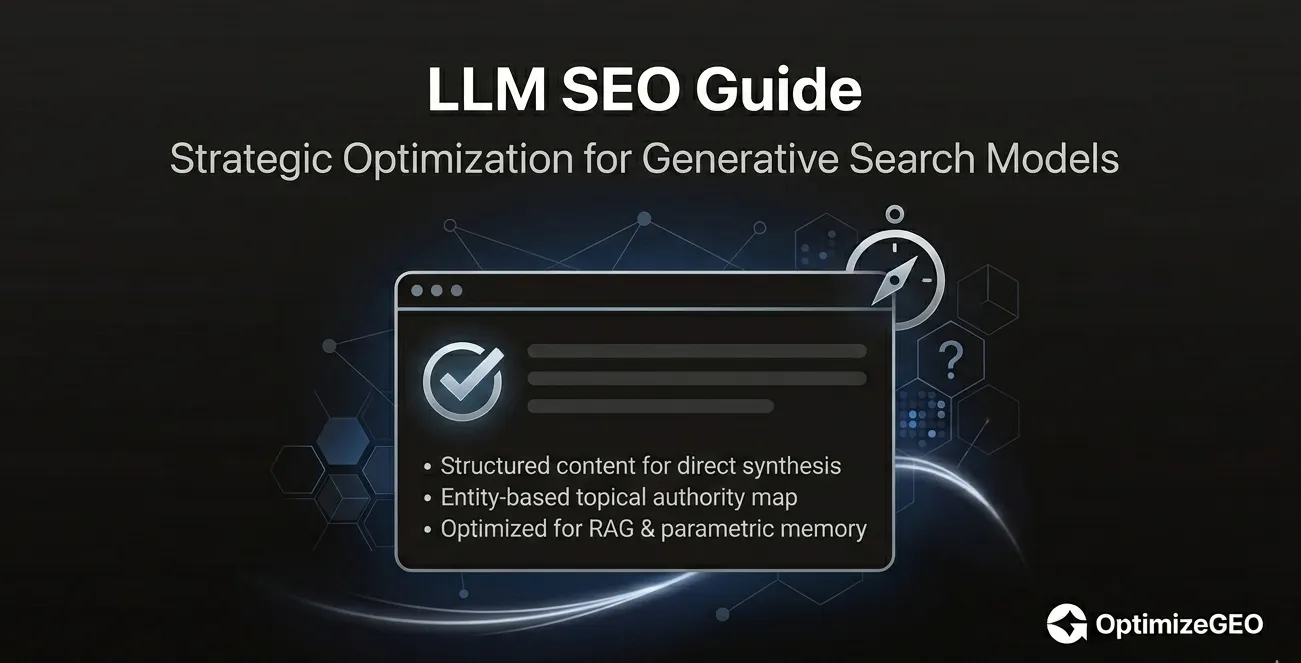
LLM SEO is the practice of optimizing content so Large Language Models find, understand, and cite it in their responses. That's the cleanest one-sentence definition - and if you haven't started thinking about it yet, here's your nudge: 45% of people now use AI platforms weekly (Wellows, 2026), and AI-driven search queries are up 300% year-over-year.
Your audience is already asking AI instead of Googling. The question is whether AI is mentioning you when they do.
8 Core LLM SEO Strategies at a Glance
- Set up Bing Webmaster Tools
- Deploy comprehensive schema markup
- Build conversational content + FAQ mirroring
- Answer autocomplete questions directly
- Maintain a consistent content freshness cadence
- Optimize for entity-based relevance
- Build third-party authority across the web
- Add an llms.txt file to your site
What Is LLM SEO? Definition and Key Terms
LLM SEO - also called LLMO (Large Language Model Optimization) or large language model optimization - all refer to the same thing: getting your content selected and cited by AI systems when they generate answers.
The terms are used interchangeably across the industry. Whether someone says LLM SEO, LLMO, or AI search optimization, they're describing the same goal.
The simplest way to understand how it differs from what came before: Traditional SEO gets you ranked. LLM SEO gets you quoted.
Here's how the three approaches compare:
| Factor | Traditional SEO | LLM SEO / LLMO | AEO |
|---|---|---|---|
| Goal | Rank on a results page | Get cited in AI responses | Be the direct answer |
| Key Input | Keywords, backlinks, technical SEO | Structured content, entity signals, freshness | Schema, answer-first format |
| Output | A link on a ranked list | A brand mention or citation in AI output | A sourced answer in AI |
| Success Metric | Rankings, organic traffic | AI citation frequency, AI Share of Voice | Prompt citation rate |
| Primary Platform | Google, Bing | ChatGPT, Perplexity, Gemini, all LLMs | Google AI Overviews, ChatGPT |
For a broader look at how GEO fits into this picture, see What is GEO?
Why LLM SEO Matters More Than Ever in 2026
The market projections are hard to ignore. Semrush forecasts that AI-driven traffic will overtake traditional organic traffic by 2028. The brands building their AI search visibility now are the ones who'll have a structural advantage when that crossover happens.
A few more numbers worth sitting with:
- 19% of marketers are already adding LLM SEO to their strategy in 2025 (HubSpot) - adoption is accelerating fast
- 45.5% of AI citations get replaced when the same AI generates a new answer to the same question (Ahrefs, November 2025) - this shows why a one-time optimization isn't enough
- AI search queries have grown 300% year-over-year, with no sign of slowing
That last stat about citation replacement is particularly important. It means AI citations aren't stable the way a page-one ranking can be - they shift constantly based on content freshness, source authority, and query context. An ongoing AI SEO strategy in 2026 isn't a project you complete. It's a system you run.
How LLMs Find and Select Content to Cite
Most people assume LLMs just know things
from training. The reality is more layered - and understanding it is key to knowing how to rank in AI search effectively.
There are three distinct layers at play:
Layer 1 - Training Data (Parametric Memory). What the model learned during training. This is baked in - you can't change it directly. Brands with strong pre-2024 online presence have an embedded advantage here.
Layer 2 - Real-Time Web Search via RAG. Retrieval-Augmented Generation. When a user asks a real-time question, the LLM fires off web searches, retrieves recent content, and incorporates it into the answer. This is where most active LLM SEO work happens.
Layer 3 - Agentic Scraping. More advanced AI agents can crawl specific URLs or data sources on demand. As agentic AI use grows, how crawlable and readable your site is becomes increasingly important.
One mechanism most people don't know about: fan-out queries.
When you ask a complex question - say, What's the best CRM for a 50-person SaaS company?
- the LLM doesn't run one search. It breaks the question into multiple shorter sub-queries, searches each independently, then synthesizes the results. This means your content needs to surface for the component parts of a question, not just the full query. It's one reason why comprehensive, topically deep content consistently outperforms thin pages in AI citations.
8 LLM SEO Strategies to Rank in AI-Generated Answers
1. Set Up Bing Webmaster Tools
ChatGPT's real-time search runs through Bing's index. If Bing hasn't crawled your site, ChatGPT can't cite it - full stop. Bing Webmaster Tools is free and takes under an hour to set up. It's the most overlooked prerequisite in any LLM SEO checklist.
2. Comprehensive Schema Markup
FAQPage, Article, HowTo, and Product schema all improve how AI systems parse and cite your content. Stack these where appropriate - a single blog post can legitimately carry FAQPage + Article schema simultaneously. This also improves your eligibility for featured snippet positions, which feeds back into AI citation probability.
3. Conversational Content + FAQ Mirroring
Write how people ask AI questions - full sentences, natural language, specific scenarios. Then add FAQ sections that directly mirror common prompt patterns. AI systems reward content that already looks like the answer it wants to give.
4. Answer Autocomplete Questions
Use tools like AlsoAsked or AnswerThePublic to find the People Also Ask
and autocomplete questions in your niche. Write tight, clear answers to each. These questions closely match the sub-queries that LLMs generate during fan-out processing.
5. Content Freshness Cadence
With 45.5% of citations shifting on re-query (Ahrefs), stale content is a real liability. Set a quarterly review schedule for your core pages - update stats, refresh examples, and re-publish with a new date. Perplexity in particular rewards freshness heavily. See the full 90-day GEO success roadmap for a practical cadence model.
6. Entity-Based Optimization
AI systems don't just match keywords - they map entities (brands, people, concepts, products) and relationships between them. Make sure your brand is clearly described, your key people have author profiles, and your content links concepts explicitly. Wikipedia, LinkedIn, Crunchbase, and Wikidata profiles all reinforce entity recognition.
7. Third-Party Authority Building
When multiple credible sources mention your brand in similar contexts, AI systems develop higher confidence in citing you. PR coverage, guest contributions, analyst mentions, and academic references all contribute. Check how intent-based modeling can inform which topics to target for authority building.
8. llms.txt File Deployment
A llms.txt file (placed at your root domain, like robots.txt) tells LLM crawlers which pages to prioritize and how to interpret your content. It's a relatively new standard, but adoption is growing. Deploying an llms.txt file is one of the most direct signals you can send to AI crawlers - and most competitors haven't done it yet. See how to prepare your website for LLM searchability for a technical walkthrough.
Platform-Specific LLM SEO: ChatGPT, Gemini, Perplexity, Claude
Each platform has its own source selection logic. Optimizing broadly is good - optimizing for each platform's specific behavior is better.
| Platform | Source Preference | Citation Behavior | Key Optimization Lever |
|---|---|---|---|
| ChatGPT | Google index (via Bing for real-time) | Favors frequent, consistent web mentions | Bing + Google indexation both required |
| Perplexity | 3-layer reranking, Reddit bias | Rewards freshness heavily, community content | Recent publications + Reddit presence |
| Gemini | Google index + YouTube | Cites YouTube video transcripts alongside web | YouTube content with transcripts enabled |
| Claude | Hacker News, academic sources | Strong preference for technical + research content | Academic citations, technical depth |
How to Track LLM SEO Performance
Google Analytics alone won't cut it here. It doesn't tell you how often ChatGPT mentions your brand, which competitors are getting cited instead of you, or how your AI Share of Voice is trending.
The metrics that matter for LLM SEO:
- Citation Frequency - How often does your brand appear in AI responses for your target prompts?
- AI Share of Voice - What percentage of relevant AI responses mention you vs. competitors?
- Prompt Performance Rate - For a defined set of test prompts, how often are you cited?
- AI-Referred Sessions - Traffic from ChatGPT, Perplexity, Gemini tracked separately in GA4
Setting up AI referral tracking in GA4: Create a custom channel group that captures sessions from chat.openai.com, perplexity.ai, gemini.google.com, and claude.ai as separate channels.
For AI Share of Voice and prompt tracking specifically, the OptimizeGEO GEO Dashboard is purpose-built for this. See how this worked in practice in the Zamp AI Search Foundation Case Study and the Global Beauty Brand AI Visibility Case Study.
LLM SEO vs Traditional SEO: Can You Do Both?
Yes - and you should. For Google AI Overviews, the correlation between traditional SEO rankings and AI citations is strong: 76.1% of URLs cited in AI Overviews also rank in the top 10 organic results.
For ChatGPT, the correlation is weaker. ChatGPT will cite a lower-ranking page if it's contextually more relevant, more comprehensive, or more recently published.
The right mental model: LLM SEO is a layer that sits on top of traditional SEO, not a replacement for it. For the practical overlap between these approaches, see GEO & SEO Best Practices 2026.
LLM SEO for Brands: Getting Started Checklist
- Google indexation confirmed for all key pages
- Bing Webmaster Tools set up and sitemap submitted
- FAQPage schema deployed on relevant pages
- llms.txt file added to root domain
- Entity profiles created/updated on Wikipedia, LinkedIn, and Crunchbase
- Author bios with clear credentials on all content
- Content freshness schedule set (quarterly minimum)
- AI visibility baseline measured (citation frequency + AI SOV)
- Competitor AI SOV benchmarked
- Quarterly review scheduled - treat AI search visibility like a live metric
The Step-by-Step Guide to GEO 2026 maps out the full execution sequence. For pricing on OptimizeGEO's tracking and optimization tools, see OptimizeGEO Pricing.
FAQs
What does LLM SEO stand for?
LLM SEO stands for Large Language Model Search Engine Optimization. It refers to the practice of optimizing your content so AI platforms like ChatGPT, Gemini, Perplexity, and Claude select it as a cited source when generating answers. It is also called LLMO (Large Language Model Optimization) - both terms describe the same discipline.
Is LLM SEO different from GEO?
They're closely related. GEO (Generative Engine Optimization) is the broader practice of optimizing for AI-generated search experiences. LLM SEO is a more specific term focused on getting cited within Large Language Model responses. In practice, the strategies overlap heavily - most people use the terms interchangeably, though GEO tends to include a wider range of AI search surfaces.
Do I still need traditional SEO if I do LLM SEO?
Yes. Traditional SEO is still the foundation. Most AI platforms, including Google AI Overviews and ChatGPT, pull from search indexes - so if your pages aren't indexed, they can't be cited. Think of LLM SEO as a layer you add on top, not a swap-out.
What is a fan-out query in LLM SEO?
When a user asks a complex question, LLMs don't run one search - they break the question into multiple shorter sub-queries and search each independently before synthesizing an answer. This means your content needs to surface for the component parts of a topic, not just the full question. Comprehensive, topically deep content performs better for this reason.
What is an llms.txt file and do I need one?
An llms.txt file is a root-level file (similar to robots.txt) that tells AI crawlers which pages on your site to prioritize and how to interpret your content. It's a relatively new standard and not yet universally adopted - but early adoption gives you an advantage. If you're serious about LLM SEO, yes, you need one.
How long does LLM SEO take to show results?
It varies by platform and starting point. Brands with strong existing SEO foundations typically see measurable AI citation improvements within 6-12 weeks of structured implementation. Unlike traditional SEO rankings, AI citations can shift faster - both in your favour and against you - so ongoing monitoring is essential.
Which LLMs should I prioritize for optimization?
Start with ChatGPT and Google AI Overviews - they collectively account for the majority of AI-driven referral traffic. Perplexity is the third priority, especially for research and technical audiences. Claude and Gemini round out the top five.
How do I track when ChatGPT cites my website?
The most reliable method is to set up GA4 custom channel groups that capture chat.openai.com as a referral source, then monitor AI-referred sessions over time. For citation frequency tracking - seeing how often ChatGPT mentions your brand without necessarily driving a click - you need a dedicated tool like OptimizeGEO, Otterly.AI, or similar AI monitoring platforms.