
Answer Engine Optimization (AEO): Complete 2026 Guide to AI Citations
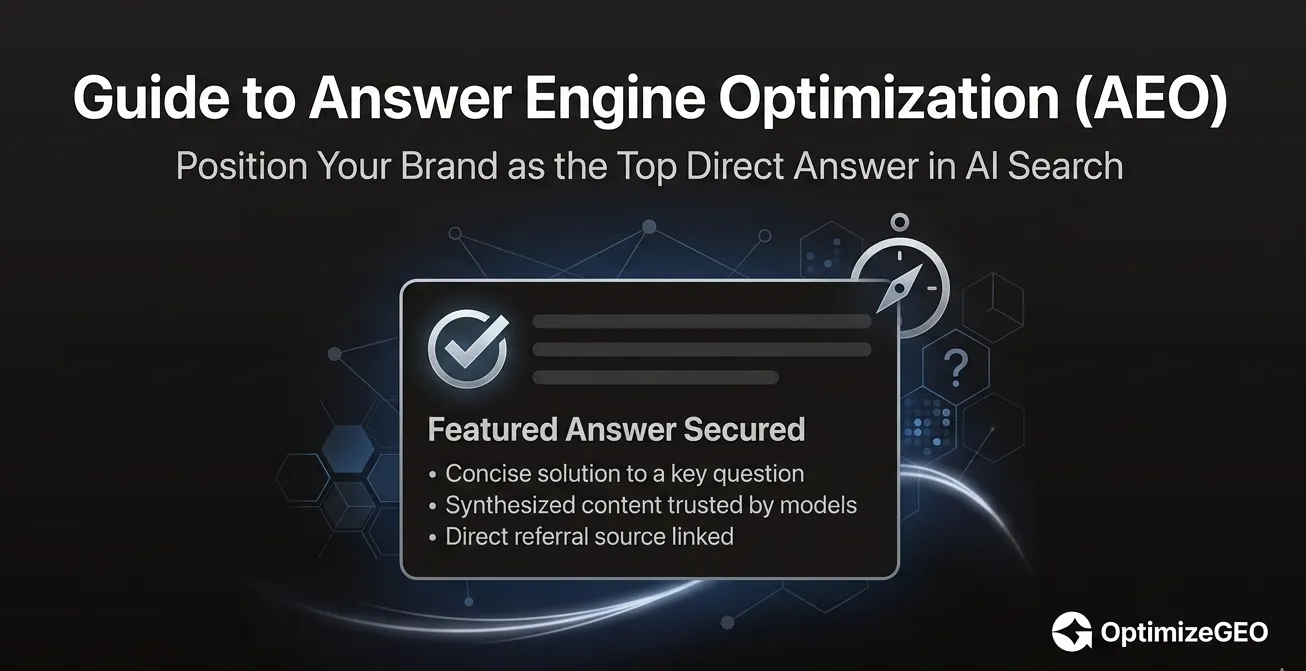
Answer engine optimization (AEO) is no longer a niche concept - it's quickly becoming one of the most important pillars of any modern digital marketing strategy. If your brand isn't showing up as a cited source in ChatGPT, Gemini, or Google AI Overviews, you're already losing ground.
Here's something that puts things in perspective: the keywordanswer engine optimization
itself has a 78% zero-click search rate in 2026 (Similarweb). People are getting their answers directly from AI - without ever visiting a website.
TL;DR - 5 Things You Need to Know:
- AEO is about being the cited answer, not just ranking on a list
- Zero-click searches now account for 69% of all searches (up from 56% in 2024)
- AI-referred traffic converts 4.4x better than organic traffic
- LLMs typically cite only 2-7 domains per response - the window is narrow
- Tools like OptimizeGEO help you track and improve your AI citation performance
What Is Answer Engine Optimization (AEO)?
AEO is the practice of structuring content so AI-powered platforms select it as a cited source when generating answers. That's the cleanest definition, and it's worth keeping front and centre.
Where traditional SEO gets your page onto a ranked list, AEO gets your content pulled directly into AI-generated responses - with your brand name attached. Think of it this way: SEO puts you in the running. AEO makes you the answer.
If you've ever asked ChatGPT a question and seen it reference a specific brand or article, that's AEO working (for someone else, possibly). The goal is to make it work for you.
Why AEO Matters in 2026: The Data Behind the Shift
The numbers aren't subtle. Here's what the data says:
- 69% of searches are now zero-click (up from 56% in 2024) - users are reading answers directly from AI summaries, not clicking through
- ChatGPT has 800M+ weekly users and is actively used for product research, comparisons, and recommendations
- AI-referred traffic grew 527% YoY through mid-2025 (Ahrefs)
- AI visitors convert 4.4x better than standard organic traffic (Gartner)
If that doesn't make AI search optimization a priority right now, nothing will.
The shift is structural, not cyclical. AI platforms aren't going away - they're becoming the default research starting point for a massive segment of your target audience. An AEO strategy in 2026 isn't optional. It's catch-up for most brands.
AEO vs SEO: What's the Difference?
A common question - and a fair one. Here's a side-by-side breakdown:
| Factor | SEO | AEO |
|---|---|---|
| Goal | Rank on a results page | Become the cited answer |
| Success Metric | Rankings, organic traffic | AI citation frequency, AI Share of Voice |
| Ranking Factor | Backlinks, keywords, page authority | Structured content, E-E-A-T, schema markup |
| Content Format | Long-form, keyword-rich pages | Answer-first, citable, structured |
| Output | A link on a list | A sourced answer in an AI response |
The key thing to understand is that AEO and SEO are not competing strategies - they're complementary. Strong SEO foundations (domain authority, indexation, quality content) still matter for AEO. But AEO layers additional signals on top: structured data, answer-first formatting, and authority signals that AI systems specifically look for.
For a deeper look at how both work together, see our guide on GEO & SEO Best Practices 2026.
How AI Answer Engines Select Sources
Most AI platforms use something called RAG - Retrieval-Augmented Generation. In plain terms: the AI retrieves relevant content from the web (or a curated index), uses it to generate an answer, and cites the sources it pulled from.
But each platform does this a little differently.
How ChatGPT Chooses What to Cite
ChatGPT uses Google's index (via SerpAPI) for real-time queries. It tends to favour content that is comprehensive, well-sourced, and clearly structured. One important implication: if Google hasn't indexed your page, ChatGPT likely won't cite it - so standard SEO indexation is still a prerequisite.
The scale of this matters: 87.4% of all AI referral traffic currently comes from ChatGPT (Conductor, 2025). Getting featured there is the single highest-leverage move in AI citation optimization.
How Gemini Selects Sources
Gemini (Google's AI) draws from Google's own index, cross-referenced with its knowledge graph and authoritative sources. It gives more weight to E-E-A-T signals than most other platforms - meaning demonstrated expertise, authoritativeness, and trustworthiness in your content and domain profile are especially important. Fresh, regularly updated content also tends to perform better here.
How Google AI Overviews Work
Google AI Overviews pull directly from Google's search index, which explains why 76.1% of AI Overview citations also rank in the top 10 organic results (Similarweb). There's a clear overlap between traditional SEO and AI Overview visibility - but it's not 100%.
One critical data point for 2026: position 1 CTR drops by 58% when an AI Overview is present. This makes AI overview optimization a priority even for brands already ranking well. Understanding the distinction between AI Mode and AI Overviews is now part of any serious GEO strategy.
7 Proven AEO Strategies to Get Your Brand Cited
Here are the tactics that consistently move the needle:
1. Answer-First Content Structure
Lead with the direct answer in the first 2-3 sentences. AI engines scrape the top of your page first - if the answer isn't there, you're often skipped.
2. Schema Markup Stacking
Layer FAQPage + Article + HowTo schema where relevant. This dramatically improves your eligibility for featured snippet optimization and AI-generated responses.
3. E-E-A-T Signals
Experience, Expertise, Authoritativeness, and Trust aren't just Google guidelines - they're signals that most AI platforms use to evaluate source credibility. Author bios, citations, and original research all count.
4. Content Freshness
AI platforms prefer recent, updated content. A quarterly refresh cycle for your key pages keeps you competitive. Stale content gets deprioritized.
5. Multi-Source Authority Building
Getting mentioned across multiple credible publications increases the probability that AI systems treat you as an authoritative source. PR, guest contributions, and citations all help here.
6. Structured Data Comparison Tables
Tables are highly citable. When you're covering AEO vs SEO comparisons, product specs, or feature breakdowns - put them in a clean HTML table with proper schema. AI systems love structured, easily parsable data.
7. Prompt-Aligned FAQ Sections
Build FAQ sections that mirror how real users phrase questions to AI platforms. This is one of the most direct ways to learn how to rank in AI search - you're essentially pre-answering the prompts. See how to prepare your website for LLM searchability for a practical walkthrough.
How to Measure AEO Performance
Traditional SEO tools don't measure this. Google Search Console won't show you how often ChatGPT cites your brand. That's the gap.
AEO performance requires a new set of metrics:
- AI Citation Frequency - How often does your brand appear in AI-generated responses for target queries?
- AI Share of Voice - What percentage of relevant AI responses mention you vs. competitors?
- Prompt Citation Rate - For a defined set of prompts, how often are you cited?
- AI-Referred Traffic in GA4 - Segment your GA4 traffic to isolate visits from ChatGPT, Perplexity, Gemini, and others
For GA4 AI referral tracking, create custom channel groups that capture traffic from chat.openai.com, perplexity.ai, gemini.google.com, and similar sources. This gives you a direct read on how much of your traffic is now AI-driven.
Platforms like OptimizeGEO, Similarweb AI Search Intelligence, and Profound are purpose-built for this measurement layer.
AEO for Specific Industries: CPG, Fintech, E-commerce
AEO isn't one-size-fits-all. The application varies meaningfully by vertical:
CPG (Consumer Packaged Goods)
AI is increasingly handling what product should I buy for X
queries. Product schema, ingredient lists, and benefit-led content optimized for recommended product queries are the priority here. See how it worked for a global beauty brand in this case study.
Financial Services / Fintech
Trust is the core challenge. AI platforms apply much stricter E-E-A-T filters to financial content - rightly so. Compliance-safe, clearly attributed, regularly updated content is non-negotiable. See how Zamp used an AI Search Foundation to build authority in this space.
E-commerce
Product schema combined with genuine customer reviews is the highest-leverage combination. AI platforms are increasingly surfacing specific products in response to purchase-intent queries - structured product data and review markup make you eligible. Intent-based modeling is particularly effective here.
OptimizeGEO for Answer Engine Optimization (AEO)
OptimizeGEO is built specifically for brands that want to win in AI search - not just traditional organic. The platform tracks your AI citation frequency across ChatGPT, Gemini, Perplexity, and Google AI Overviews, giving you the visibility that standard SEO dashboards simply don't offer.
Beyond tracking, OptimizeGEO surfaces actionable recommendations - schema gaps, content structure issues, E-E-A-T signals that need strengthening, and competitor citation patterns. It maps directly to the 90-day GEO success roadmap so you're always working a clear, prioritized plan.
If zero-click search is eating your organic traffic and you're not sure where you stand in AI responses, this is where to start. Check OptimizeGEO pricing to find the right plan.
FAQs
What is the difference between AEO and SEO?
SEO focuses on ranking your website on search engine results pages through keywords, backlinks, and technical optimization. AEO focuses on structuring your content so AI platforms cite it as the source when generating answers. SEO gets you on the list; AEO makes you the answer. Both strategies are complementary and work best when used together.
Is AEO the same as GEO?
They overlap significantly. GEO (Generative Engine Optimization) is the broader practice of optimizing for AI-generated search experiences, while AEO specifically targets getting cited as a source in AI answers. AEO is effectively a subset of GEO, with a sharper focus on citation and attribution within AI responses.
Does AEO replace SEO?
No. AEO and SEO work together. Strong SEO foundations - domain authority, indexation, quality content - are still prerequisites for AEO success. Most AI platforms, including ChatGPT and Google AI Overviews, pull from search indexes, so if SEO isn't solid, AEO won't work either.
How do I get my website cited by AI platforms?
Start with answer-first content structure, implement FAQPage and Article schema markup, build E-E-A-T signals (author credentials, citations, original data), and ensure Google has properly indexed your pages. Tracking your performance with a dedicated tool like OptimizeGEO helps you identify gaps and prioritize improvements.
What schema markup is most important for AEO?
FAQPage, Article, and HowTo schema are the highest priority for most sites. Product schema matters heavily for e-commerce. Stacking these where appropriate - rather than using just one - improves your eligibility across multiple AI response types and featured snippet optimization opportunities.
How do I measure AEO performance?
Track AI citation frequency, AI Share of Voice, and AI-referred traffic in GA4 (segment by referral source: chat.openai.com, perplexity.ai, gemini.google.com). Traditional SEO tools don't cover this - platforms like OptimizeGEO, Profound, and Similarweb AI Search Intelligence are purpose-built for it.
How often should I update content for AEO?
A quarterly refresh is the minimum recommended cadence for key pages. AI platforms deprioritize stale content, and the search landscape is shifting fast enough in 2026 that outdated stats or missing schema can cost you citations. High-priority pages in competitive niches may warrant monthly reviews.
Does voice search count as AEO?
Yes - voice search is closely related. Voice assistants (Siri, Google Assistant, Alexa) pull answers from similar structured content sources. Optimizing for AEO naturally improves your voice search visibility since both rely on direct, clearly structured, schema-marked-up answers rather than traditional ranked listings.